Wholesale Supplies Plus Batch Calculator . Source high quality products in. Print this article (enlarge image) many people are given a formula based on percentages. 12 Digits Display Desktop Calculator with 6 Inch LCD Writing Tablet from www.shoppingsquare.com.au Wholesale supplies plus batch calculator. Results show the balance of the formula. Insert your recipe in percentages and set the batch size.
How To Calculate Probability In Python. Numpy’s random.choice () to choose elements from the list with different probability. This method takes 3 values:
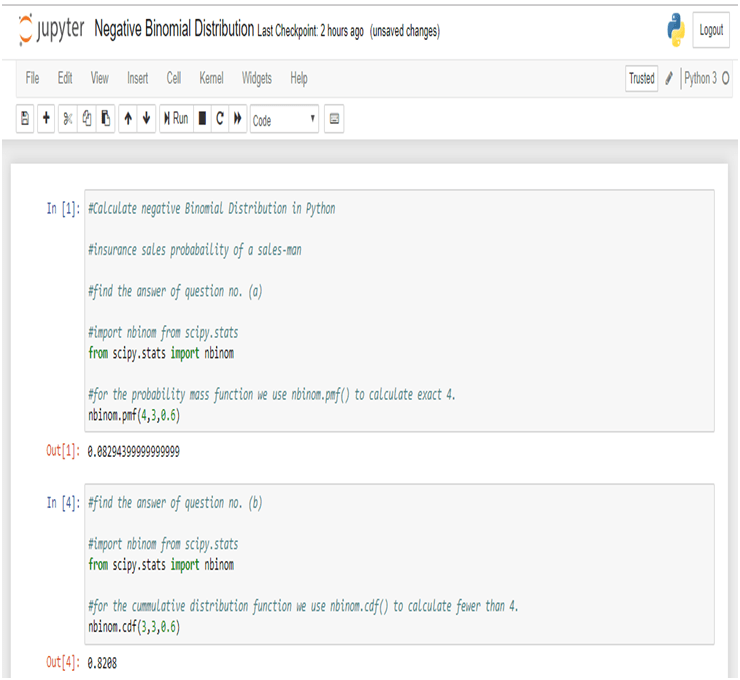
Statistical Application in R & Python Negative Binomial Distribution from www.dexlabanalytics.com
Each predicted probability is compared to the actual class output value (0 or 1) and a score is calculated that penalizes the probability based on the distance from the expected value. Theory and formula behind conditional probability. The penalty is logarithmic, offering a small score for small differences (0.1 or 0.2) and enormous score for a large difference (0.9 or 1.0).
Theory And Formula Behind Conditional Probability.
The binom.pmf() method from the scipy.stats library can be used to calculate the pmf of the binomial distribution at any value. At this point, it might be a good idea to begin. There are multiple ways to do this, but to view the code i used, feel free to check out the kaggle notebook.
The Penalty Is Logarithmic, Offering A Small Score For Small Differences (0.1 Or 0.2) And Enormous Score For A Large Difference (0.9 Or 1.0).
In this course, you'll learn about fundamental probability concepts like random variables (starting with the classic coin flip example) and how to calculate mean and variance, probability distributions, and conditional probability. You can visualize a binomial distribution in python by using the seaborn and matplotlib libraries: We also got an intuition on what the shape of different distributions looks like when plotted.
Divide The Number Of Events By The Number Of Possible Outcomes.
Third, you will learn to calculate probabilities and to apply bayes theorem directly by using python. Use secrets on python 3.6+ and os.urandom() on python 3.5 and earlier. Identify the total number of outcomes that can occur.
Run The Experiment 1000 Times (Roll 2 Dice 1000 Times, And Sum The Result) Keep Track Of The Number Of Times That The Sum Was Either Greater Than 7 Or Even.
Define the constants for this problem. Install numpy using a pip install numpy. Next, you will learn about conditional probability and bayes theorem.
Print The Results To The Python Interpreter.
In a $1d$ normal distribution case this would be the area under the two tails of the pdf. The multiplication rule for independent events. Finally, you will learn to work with both empirical and theoretical distributions in python, and how to model an empirical data set by using a theoretical distribution.


Comments
Post a Comment